|
Short Danube Swabian History
By
Rosina T. Schmidt
Edited by Cornelia Brandt
Even though there are no
exact borders of the formal Danube Swabian Ancestry Land today, we are speaking
of the Danube Basin as the general location.
The Danube Basin, part of
greater Hungary, was occupied by the Ottoman Empire (Turks) for over 150 years.
It was freed by the joint forces of the Germans, Poles, Magyars, Serbs, Croats,
and other nationalities under the Austrian Emperor’s mantle in the wars of
1683-1699 and 1716-1718.
The
Turkish rule ended with the peace treaties of Kilobits and Passarowitz. The
whole of Hungary, most of it devastated and depopulated, was reunited under the
Habsburg crown. It was then necessary to repopulate the land with taxpayers and
soldiers. A Military Zone was established as a bulwark between the Austrian and
the Ottoman Empires (Turks), and settled with soldier-farmers from different
nationalities.
The Military Zone in 1840
Even though 30,000 Serbs settled in non-military-zone as refugees in 1690, their numbers
and agricultural skills were insufficient. The Emperor in Vienna started bringing
settlers from all over the Empire, but the Germans from the various duchies,
principalities and kingdoms, seemed best suitable for Habsburg ideas, as they were
thrifty, law-abiding, diligent, peace loving and willing to strive for better life than
they had back ‘home’.
The colonization
took place in several waves, named after the Emperor of the day:
1.
The “Karl Impopulation” which
occurred from 1718 to 1737;
2.
The “Maria Theresia
Impopulation, from 1744-1772;
3.
The
“Joseph Impopulation”, which took place under Joseph II from 1782-1787.
Many of the approximately
15,000 German settlers from the first colonization were killed in Turkish raids or
died from bubonic plague. The second major migration of approximately 75,000
German colonists had to rebuild the settlements all over again. It took much hard
work to re-establish the towns, clear-cut the forest, and turn the wilderness into
fields. With the third wave of approximately 60,000 German settlers, the economic
prosperity of the Hungarian farmland was secure.
The
Habsburg Emperor reserved all of the Banat area as his own domain. The government was
eager for the colonists to be successful in the shortest possible time, so the settlers
were given financial aid, tax exemption for some years, a free house in Banat, grain,
tools and other items.
At
the same time the individual landowners (Nobility and the churches) tried to entice the
colonists with better promises to settle on their land instead. And many did, even though
the only financial aid they received when settling on manorial estates was the tax
exemption of three years. The settlers also had to have 200 Gulden as starting capital.
The embarkation
point for their journey was the cities of Ulm in Swabia and Regensburg in Bavaria, both on
the River Danube, which was the major traffic route to South-East Europe. As more and more
colonists headed for Hungary, soon special river floats were built. These Ulmer
Schachteln, transported the travelers down the River to Vienna where the settlers had
to register in order to receive the information and destination documents. Both Emperor
Karl VI and Maria Theresia insisted on Roman Catholic settlers only, but others were
eventually permitted to enter the land as well, in order to speed up the colonization.
With the emigration from the
various German duchies, principalities and kingdoms, the Swabian colonists
continued to stay loyal subjects of their Holy Roman Emperor. He was at the same
time also the King of Hungary. The settlers were invited to bring their customs,
their language, their teachers, priests and pastors with them. Over time the
connection to the old homeland diminished all together, as Danube Swabians became
a recognized minority in what later was known as the Empire of Austro-Hungary.
The earliest major
Danube Swabian settlements were
Swabian Turkey (counties Tolna, Baranya and Somogy south of Lake Balaton), Banat (east
of the Tisa River), Batschka (between the Rivers Danube and Tisa) and Syrmien (the
eastern-most corner between Danube and Sava Rivers). The renowned thriftiness and working
habits of the ethnic Germans colonists made it possible for the Danube Basin, also known
as the Pannonian Plain, to become the breadbasket of Europe by the third generation. Their
prosperity brought also a population explosion, and new areas for settlement were opened
up: Slavonia (after 1865) and later Bosnia. In both cases mostly the Danube Swabian sons
and daughters from the Swabian Turkey bought farms there and soon prospered also.

Austro-Hungary
in 1867
In 1910 about
1.5 million Danube Swabians lived in Austro-Hungary in five major settlement
areas.
390,000 ethnic Germans
in 130 communities in the Banat (23 percent of the population)
190,000 in 44 villages
of the Batschka (24.5 percent),
150,000 in the Swabian
Turkey (35 percent),
126,000 in Slavonia and
Syrmien (11 percent) as well as
80,000 in Budapest (9
percent).
See also
Swabian Turkey History.
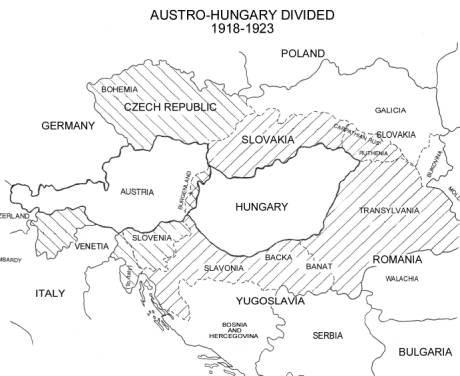
The
winds of change were not kind to Austro-Hungary in 1918. It lost the war (WWI, together
with Germany) and Austro-Hungary was divided in eight different parts at the Treaty of
Trianon (4th June 1920). This resulted that now the 1.5 million of Danube Swabians were
split in three different successor states of the Habsburg Monarchy.
The
eastern Banat and Sathmar fell to Romania.
The western Banat,
the Batschka, the southern Baranya triangle, Syrmien and Slavonia went to the newly
created Kingdom of the Serbs, Croats and Slovenes (from October 1929: Yugoslavia).
The remaining settlement areas stayed in what was left of Hungary, which shrank
to 31% of its previous boarders.
Some Danube Swabian
families had now close family members in different countries, where different laws,
languages and customs were imposed.
Sketch by Rosina T. Schmidt
The name "Donauschwaben" (Danube
Swabians) was created around 1920, just after Austro-Hungary was divided, by
a Robert SIEGER. The name was assumed also by the geographer Hermann RÜDIGER
from Deutsches Auslands Institut in Stuttgart in the works of DAI to
differentiate the diverse groups of ethnic Germans in south-eastern Europe. The
Donauschwaben and the Transylvanian Saxons [i.e. Siebenbürgen Sachsen / Erdélyi
Szászok / Sasi] and was used again in 1935 in the "Handworterbuch des Grenz-
und Auslandsdeutschtums" [published by Carl PETERSEN, Paul Hermann RUTH,
Otto SCHEEL, Hans SCHWALM, vol. II, Breslau, 1935, pages 290-305].
Already around the end of the
20th century many young people were looking for work in other lands,
mainly the Americas, always hoping to save enough money there to return home and
buy their own homestead. Many did so, but some decided to put their roots in
those new lands instead, where they thought the opportunities were better.
By the
time WWII spread over Europe the good fortune of the ethnic Germans changed
dramatically. Even though they were subjects of different nationalities, the
Nazis succeeded to make the ethnic Germans a pliant instrument of their foreign
policy in order to achieve Hitler’s goal of gaining Lebensraum in the
East.
It is true that some of the
Danube Swabians and other ethnic Germans did volunteer to the military service
in the German units, but it soon became a forcible recruitment to the Waffen-SS
for all able-bodied men. (Honved in Hungary and Prinz-Eugen in Yugoslavia.)
By 1944 it was clear that the
local population (Hungarians, Croats, Serbs, Romanians) used the Danube Swabians
as scapegoats for the Nazi’s atrocities. The Partisans in the Yugoslavian areas
viciously attacked many Donauschwaben villages. There was talk in Berlin about
resettlement, but the implementation of those plans if any, came too late. The
Danube Swabians in the Romanian Banat were the first who started fleeing just
ahead of the approaching Soviet Red Army, with the Slavonian Donauschwaben
following. Some Batschka and Syrmien’s Danube Swabian as well. However, most
ethnic Germans considered themselves as having had nothing to do with the Nazis
at all and decided to stay, soon to regret it bitterly.
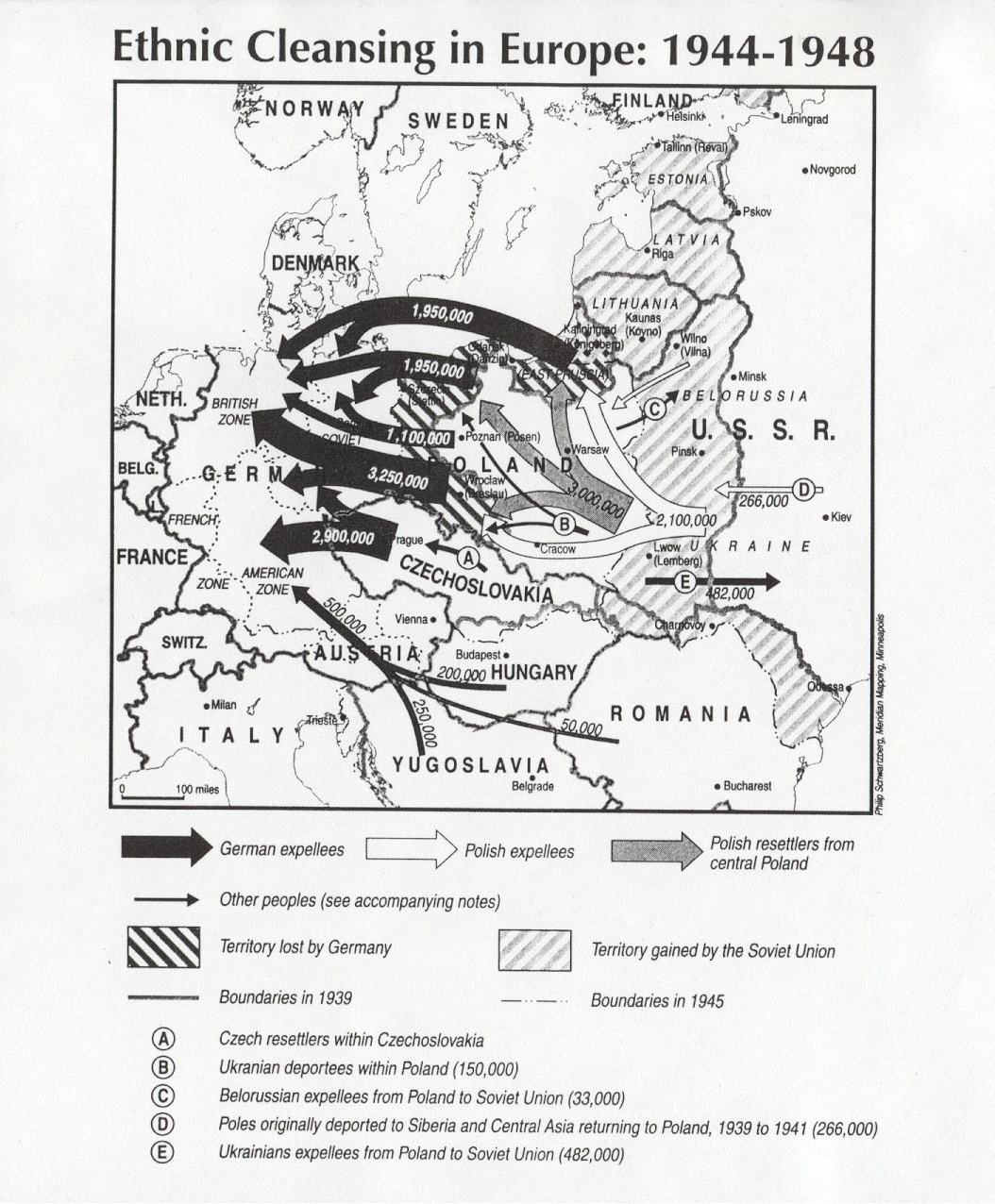
The period 1944 through 1948
was the most tragic part of the Danube Swabians 250 year history. During those
years they were subjected to victorious communist partisans and the Red Army
atrocities; they were plundered, shot en masse, incarcerated and manhandled or
were sent to the Siberian Slave Labor Camps. They were dying in the thousands
during those years. They were sent to the Baragan Steppe in Romania or the Death
Camps in Yugoslavia with the goal to eliminate them from the earth, under the
pretext of ‘collective responsibility and collective guilt’.
At the Potsdam Conference
between 17th of July to 2nd of August 1945) the Allies
(USA, Great Britain, Soviet Union) made the decision to remove the ethnic German
population from outside of Germany proper, with the understanding that it should
be carried out ‘in orderly and humane manner’. In the practice this
‘humane manner’ was nothing but illegal land-grab and inhumane treatment of some
15 million ethnic Germans of who five million were the Danube Swabians.
Most
managed to escape to Austria or Germany, but more then 1.5 million lost their
lives between the end of WWII and 1949.
Redrawing Nations: Ethnic Cleansing in East-Central Europe, 1944-1948. Edited
by Philipp Ther and Ana Siljak. Rowman & Littlefield Publishers, Inc: 2001.
Today the
Danube Swabians and their descendants are living all over the world.
Aug. 2010 |